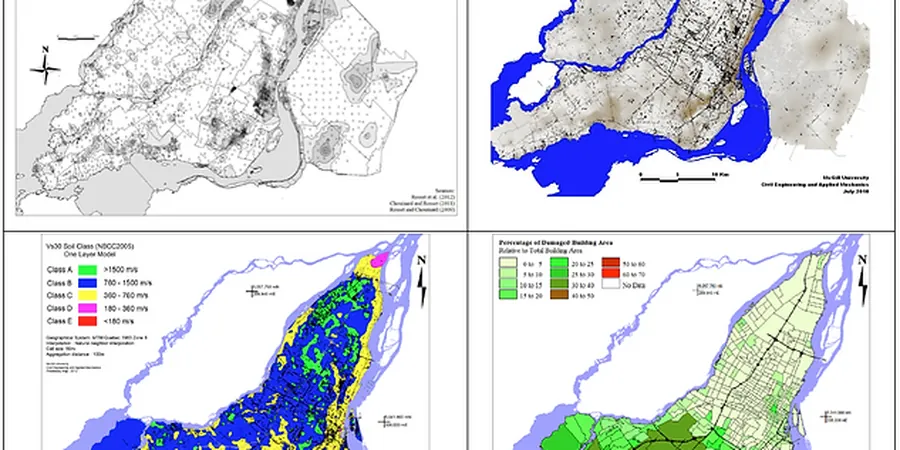
Laval’s geology shifts noticeably within a few kilometers. In Pont-Viau, you find dense till over limestone, and the ground feels firm under the rig. Head east toward Saint-François and the borehole tells a different story: ten, twelve meters of soft Champlain Sea clay before you touch rock. That contrast is why we run seismic microzonation here, not just as a desk study, but as a field-calibrated investigation. NBCC 2020 requires site-specific Vs30 for Site Class C, D, or E, and the default assumption often does not hold in Laval’s fluvial terraces. Before driving piles or cutting a basement, we combine MASW profiling with existing SPT drilling logs to map the impedance boundaries that control amplification. This is not a paper exercise; it is the difference between a structure that resonates and one that dissipates energy predictably.
In Laval, a Vs30 of 180 m/s versus 280 m/s can double the short-period spectral acceleration in your design—knowing which side of the contour you are on matters.
Local considerations
The geophone spread is live, and the sledgehammer hits the plate—the signal travels through Laval’s layered sediments, and the inversion software builds a stiffness profile in near real time. We run these arrays on active construction sites, sometimes between the piling rig and the excavator, because the data cannot wait. The biggest risk we catch is a misinterpreted Site Class. A builder assumes Site C based on a regional map, but our MASW line shows 195 m/s average—firmly Site E. The seismic demand jumps, and the lateral force-resisting system designed for a stiffer site becomes inadequate. Another pattern we see in Laval: thin crusts of desiccated clay over soft saturated material. The upper meter reads fast, misleading a simple refraction survey. That is why we always invert dispersive waves rather than trusting first arrivals alone.
Applicable standards
NBCC 2020 (National Building Code of Canada, seismic provisions), CSA A23.3-19 (Design of concrete structures, seismic ductility), ASTM D4428/D4428M-17 (Crosshole seismic testing), ASTM D7400-19 (Downhole seismic testing), NEHRP site classification (Vs30 framework)
Frequently asked questions
Does Laval's NBCC seismic hazard differ from downtown Montréal?
The uniform hazard spectra in NBCC 2020 for Laval are nearly identical to the Island of Montréal because they share the same tectonic setting. The difference lies in the site coefficients: Laval's deeper clay deposits produce higher long-period amplification factors (Fv) than the rock sites on the island, making site-specific microzonation essential.
How long does a MASW survey take on a typical Laval residential lot?
For a standard single-family lot, we can complete three MASW lines and preliminary Vs30 mapping in one field day. The report with site class and response spectra is typically delivered within five business days after the survey, weather permitting.
What does a seismic microzonation study cost in Laval?
Depending on the number of measurement points and the depth of investigation required, a seismic microzonation study in Laval ranges from CA$6,570 for a basic single-line MASW with Vs30 determination to CA$21,410 for a comprehensive campaign with multiple arrays, downhole verification, and 1D site response analysis.
Can you use existing boreholes for the microzonation instead of surface methods?
Yes, we often run downhole seismic surveys inside existing open-cased boreholes. This gives a direct interval velocity measurement without the inversion step. We just need the borehole to be open, stable, and within the project footprint.