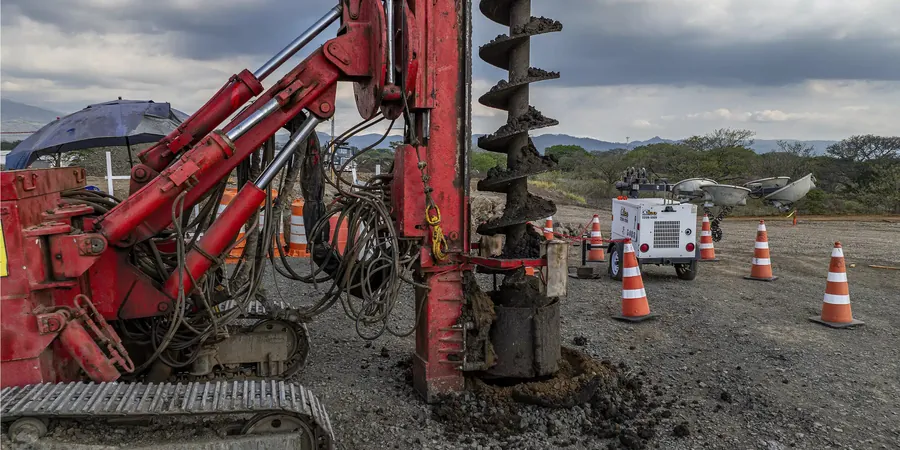
We see it repeatedly in Laval: a contractor assumes standard footings will work on a site near Rivière des Mille Îles, only to hit soft, compressible clay at 3 meters. The budget blows up when differential settlement appears before the structure is even closed in. Stone column design eliminates that risk by creating stiff, load-bearing columns through the weak zone, transferring stress to competent till or bedrock below. Our laboratory handles the full design sequence—from index testing on Shelby tube samples to verifying column modulus with post-installation load tests. For Laval’s Champlain Sea clays, which cover much of the island and can exceed 20 meters in thickness, a properly executed CPT test before design gives us the continuous profile needed to size diameter, spacing, and depth correctly, avoiding the guesswork that leads to underperformance.
A stone column in Laval’s sensitive clay is not just a load path—it is a drain. The column’s permeability, typically 10⁻³ to 10⁻² cm/s, accelerates consolidation from decades to months.
Local considerations
Laval’s geology splits into two worlds. The western plateau around Sainte-Dorothée sits on glacial till and shallow bedrock—here, stone columns are rare because bearing is good within 2 meters. Cross east toward Duvernay or Saint-François, and you enter the Champlain Sea basin, where sensitive silty clays dominate. The contrast is stark: one site might need only a compaction test for granular fill, while the next requires 15-meter stone columns designed to limit settlement under a six-story residential block. The biggest mistake we see is applying a generic column grid without accounting for Laval’s clay sensitivity. Remolded strength can drop to less than 20% of peak, so installation sequencing matters—wrong spacing triggers pore pressure buildup in adjacent columns, reducing effective confinement. These soils also carry liquefaction potential under the seismic demands of NBCC 2015 for the Montreal-Laval region, making stone columns a dual-purpose solution: settlement reduction plus drainage paths that inhibit excess pore pressure during an event.
Frequently asked questions
What does stone column design cost for a typical Laval site?
For a standard design package covering a single building footprint in Laval, the fee typically ranges from CA$1.930 to CA$7.910 depending on the number of columns, depth, and whether CPT or SPT data is already available. Sites requiring additional triaxial testing or liquefaction analysis fall toward the upper end.
How deep do stone columns need to go in Laval's clay deposits?
Most columns in Laval terminate between 9 and 25 meters, reaching the dense till or bedrock that underlies the Champlain Sea clay. The exact depth depends on the compressible layer thickness and the applied load. We determine the bearing stratum using CPT refusal data or SPT N-values above 50 blows per foot.
Can stone columns prevent liquefaction under Laval's seismic conditions?
Yes, and that is a key advantage in the Montreal-Laval seismic zone. Stone columns act as vertical drains, allowing excess pore pressure to dissipate rapidly during shaking. With spacing of 3 meters or less, the columns can reduce liquefaction potential in granular interbeds within the clay profile, which is relevant for Laval sites classified as Site Class D or E under NBCC 2015.