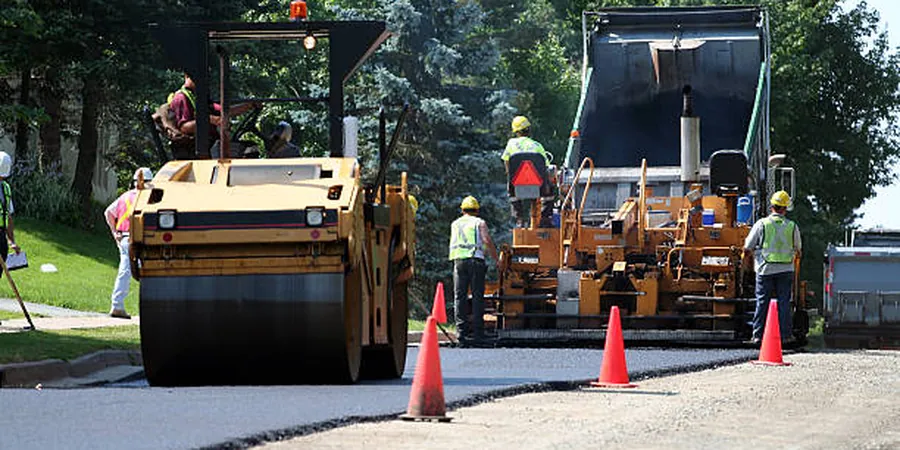
Laval sits on the Canadian Shield's northern edge, but its surface geology tells a different story — thick Champlain Sea clays that can swell, shrink, and heave with the seasons. A pavement section that ignores the underlying silty clay won't last three winters before cracking. We design flexible pavement structures that account for frost penetration depth in Sainte-Rose, drainage patterns near Rivière des Mille Îles, and the actual CBR values of the subgrade rather than assumed ones. The asphalt, base, and subbase layers get specified with materials available from local quarries, keeping the section buildable and the maintenance cycle manageable. This approach connects directly to the CBR road design methodology when subgrade strength drives the entire section.
A flexible pavement section in Laval lives or dies by its subbase drainage — trapped water in the granular layer during a January freeze will tear the asphalt by March.
Local considerations
Something we see repeatedly in Laval subdivisions: the base course gets compacted over a wet clay subgrade in late October, the asphalt goes down in November, and by April the wheelpath has longitudinal cracks every ten meters. The culprit isn't the asphalt mix — it's the trapped pore water that froze, expanded, and heaved the base upward, then left voids when it thawed. The fix starts with a properly designed subdrainage system and a subbase thick enough to act as a capillary break. The granular material also needs to meet freeze-thaw durability specs; not every local quarry product passes the magnesium sulfate soundness test. When the pavement section must support heavy industrial traffic, we run the structural number calculations through both empirical and MEPDG checks before finalizing the lift thicknesses.
Applicable standards
AASHTO 1993 Guide for Design of Pavement Structures, AASHTOWare Pavement ME Design (MEPDG), ASTM D1883-21 (CBR of laboratory-compacted soils), ASTM D4694-09(2020) (Deflection testing with FWD), MTQ Tome VII – Matériaux et fondations (Quebec reference), BNQ 2560-114 (Granular materials – Quebec standard)
Frequently asked questions
What does a flexible pavement design engagement cost in Laval?
For a typical flexible pavement design package — including subgrade investigation, layer thickness calculations per AASHTO, and construction specifications — the fee ranges from CA$2,510 to CA$7,960 depending on project length, traffic data complexity, and whether FWD verification testing is included. A short residential cul-de-sac sits at the lower end; a commercial arterial with ESAL projections and MEPDG modeling sits at the upper end.
How does the Champlain Sea clay affect pavement performance in Laval?
The Champlain Sea clay underlying much of Laval is highly frost-susceptible and loses strength when saturated. The pavement section must include an adequate granular subbase to interrupt capillary rise and provide frost protection. Without it, the clay heaves during freeze and softens during thaw, creating differential deformation that cracks the asphalt surface within a few seasonal cycles.
What design method do you use for flexible pavements?
We use the AASHTO 1993 Guide for structural number calculations as the primary framework, supplemented by the AASHTOWare Pavement ME Design (MEPDG) for performance prediction when traffic data supports it. Both methods are calibrated to Quebec climate data and local material properties, including the granular base specifications in MTQ Tome VII.
How long does a pavement design take from investigation to final report?
A typical turnaround runs three to four weeks. Week one covers subgrade sampling and CBR testing. Week two handles layer calculations and material specification. The remaining time goes to report preparation, structural number verification, and coordination with the civil engineering team for grading and drainage tie-ins.