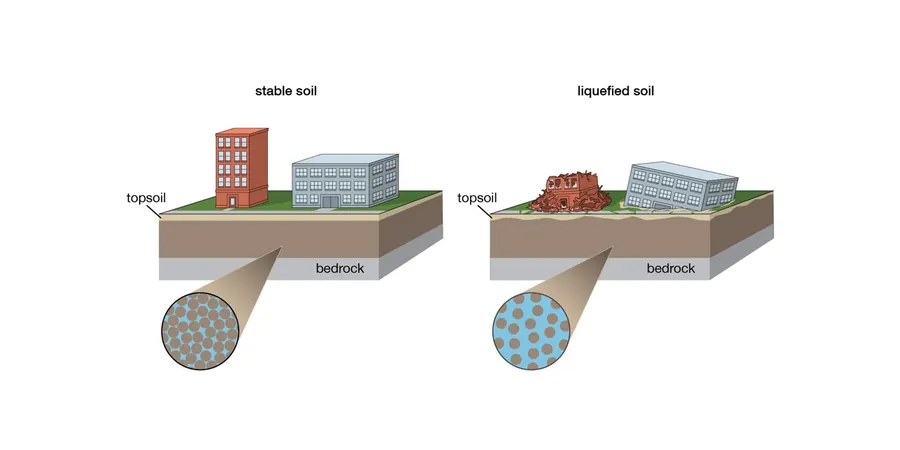
When the CPT rig’s hydraulic push system drives the cone into the silty deposits near Rivière des Prairies, the real-time data on pore pressure and tip resistance starts painting a picture that standard boreholes miss. Laval sits on the St. Lawrence Lowlands, where the post-glacial Champlain Sea left behind thick sequences of sensitive clay and loose silt—materials that behave erratically under seismic loading. Our technical team runs in-situ tests across industrial parks in Chomedey and residential subdivisions in Sainte-Rose, pairing cone penetration data with laboratory cyclic triaxial assessments to quantify how the ground will respond during the next design-level earthquake. Because the island’s variable stratigraphy means a site on one side of Autoroute 15 can behave completely differently from one half a kilometer away, we anchor every analysis in the National Building Code of Canada (NBCC 2020) site classification requirements, supplemented with CPT test profiling to capture thin liquefiable layers that SPT-only investigations often overlook.
A liquefaction analysis on Champlain Sea clay isn't just a code checkbox—it determines whether your foundation design survives the 2,475-year seismic event the NBCC requires.
Local considerations
Laval registered a population of over 440,000 in the 2021 census, making it Quebec’s third-largest city—and a substantial portion of that growth sits on soils deposited by the Champlain Sea roughly 10,000 years ago. The 1988 Saguenay earthquake (M5.9), though centered 400 km away, served as a reminder that eastern Canada’s intraplate seismicity can produce ground motions that trigger liquefaction in susceptible deposits even at considerable epicentral distances. A site with a clean sand layer at 4 meters depth and a water table at 2 meters can lose nearly all its bearing capacity within seconds of strong shaking, causing differential settlement that cracks slabs and shears utility connections. We have seen borehole logs from Laval where the SPT blow count drops below 5 in a 3-meter band of silty sand—a textbook liquefiable profile that demands analysis before a single footing is poured. Running the triggering assessment early in the design phase lets the project team evaluate mitigation costs against the risk of foundation failure, a calculation that becomes far more expensive when it is made after excavation reveals the problem.
Frequently asked questions
What does a soil liquefaction analysis cost for a typical Laval site?
For a standard single-family or small commercial lot in Laval, the analysis typically ranges from CA$3,490 to CA$5,200, depending on the number of boreholes or CPT soundings required and whether laboratory cyclic testing is included. Sites with complex stratigraphy or high-importance structures fall toward the upper end because they demand more data points and a more detailed engineering report.
How do I know if my property in Laval actually needs a liquefaction analysis?
The NBCC 2020 triggers a site-specific analysis when the ground contains saturated sands or silts with SPT N-values below 15, a water table within 3 meters of the surface, and a design PGA exceeding 0.15 g. Much of Laval meets these criteria. A review of existing geotechnical reports from nearby lots combined with one or two CPT soundings usually gives us enough data to confirm whether the risk is real or the soil is dense enough to rule out liquefaction without a full study.
What happens if liquefaction is confirmed on my site—does it stop the project?
Liquefaction does not kill a project; it defines the engineering solution. Depending on the layer depth and building loads, mitigation options range from vibrocompaction or stone columns to deep foundations that bypass the liquefiable zone entirely. We work directly with your structural engineer to model the post-liquefaction settlement and lateral spread so the mitigation design targets the specific risk, avoiding over-engineering that inflates the construction budget.