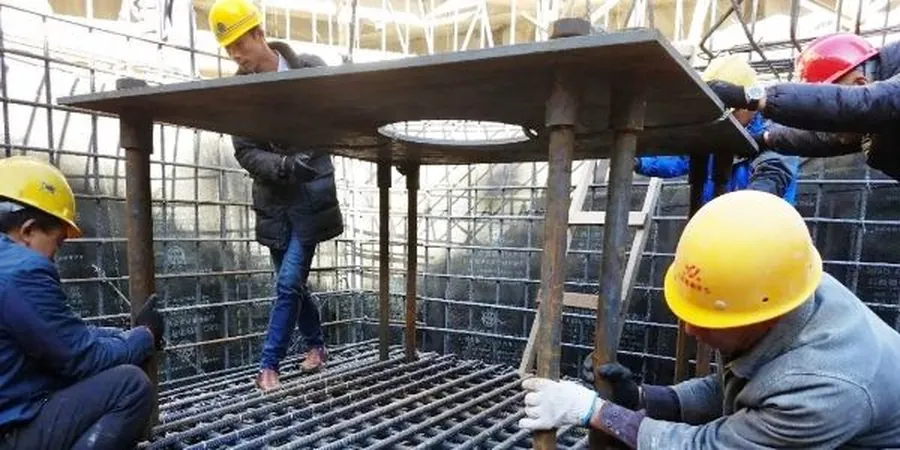
We typically arrive on site in Laval with a flatbed carrying the first set of high-damping rubber bearings, usually 600 to 900 mm in diameter, ready for placement on the pedestals. The crane lifts them one by one while the survey crew checks the leveling plates against the grid. The biggest challenge here is not the weight of the structure above but the soft, sensitive clay underneath that amplifies ground motion. In neighborhoods like Sainte-Rose or Fabreville, the stratigraphy often shows 20 to 30 meters of compressible Champlain Sea deposits before reaching competent till or rock. This soil profile makes conventional fixed-base design risky, especially east of the Mille Îles River, where long-period amplification can surprise engineers who only look at short-period spectral acceleration. A properly tuned isolation layer decouples the superstructure from that ground motion, shifting the fundamental period away from the dominant site frequency we measure during MASW surveys or downhole testing.
In Laval's soft clay basins, isolating a building at its base can cut seismic forces by 60 to 70 percent compared to a fixed-base scheme.
Methodology and scope
Soil conditions shift noticeably between Laval-des-Rapides near the Rivière des Prairies and the higher ground around Chomedey. In Laval-des-Rapides, the bedrock is sometimes 40 meters deep, buried under thick marine clay with undrained shear strengths as low as 15 kPa in the upper crust. A structure there needs an isolation system with generous displacement capacity — often 400 mm or more under the MCE level defined by NBCC 2020. In Chomedey, where glacial till is shallower at 8 to 12 meters, the isolation gap can be tighter, and we might use lead-rubber bearings combined with flat sliders to control both period shift and damping.
What we look for first is the soil class. Most of Laval falls under Site Class D or E per NBCC Table 4.1.8.4.A. That classification directly drives the spectral accelerations used in the isolation design, and it is one reason we insist on
seismic microzonation early in the project, especially for essential facilities.
The isolator testing protocol follows CSA A23.3 Clause 21 and the prototype testing sequence: three fully reversed cycles at increasing displacement, plus aging and scragging verification. Every bearing leaves our shop with a traceable QA report tied to the building permit package.
Applicable standards
NBCC 2020 — National Building Code of Canada, Seismic Provisions, CSA A23.3-14 — Design of Concrete Structures, Clause 21, CSA S16-19 — Design of Steel Structures, ISO 22762 — Elastomeric Seismic-Protection Isolators, ASCE/SEI 7-22 — Minimum Design Loads (referenced for comparative studies)
Frequently asked questions
What does base isolation seismic design cost for a typical mid-rise building in Laval?
For a mid-rise structure on Laval's typical Champlain Sea clays, engineering fees for the isolation design — including analysis, specifications, and construction support — generally fall between CA$5.200 and CA$10.710, depending on the number of isolator types and the complexity of the time-history modelling. The isolator hardware itself is a separate procurement cost and varies by manufacturer and displacement capacity.
Is base isolation mandatory in Laval under the current building code?
It is not mandatory for all buildings. NBCC 2020 permits conventional fixed-base design for normal structures, but for post-disaster buildings, essential facilities, or high-importance structures on Site Class D or E soils, an isolation or supplemental damping study is often required to meet the performance objectives set by the authority having jurisdiction.
How does the Champlain Sea clay affect the performance of base isolators?
The soft clay amplifies long-period ground motion, which is exactly the frequency range where isolated buildings operate. If the site period and the isolated structure period overlap, resonance can occur. We avoid this by targeting an isolated period at least 2.5 seconds, using site-specific response spectra derived from deep borehole data and shear-wave velocity profiling.
Can an existing building in Laval be retrofitted with base isolators?
Yes, but it is a major intervention. The building must be temporarily supported while the columns are cut and isolators are inserted. In Laval, we have evaluated retrofits for concrete frame buildings from the 1970s where the original design did not account for the soft-soil amplification now recognized in the code. The feasibility depends on the existing foundation type and the condition of the concrete.