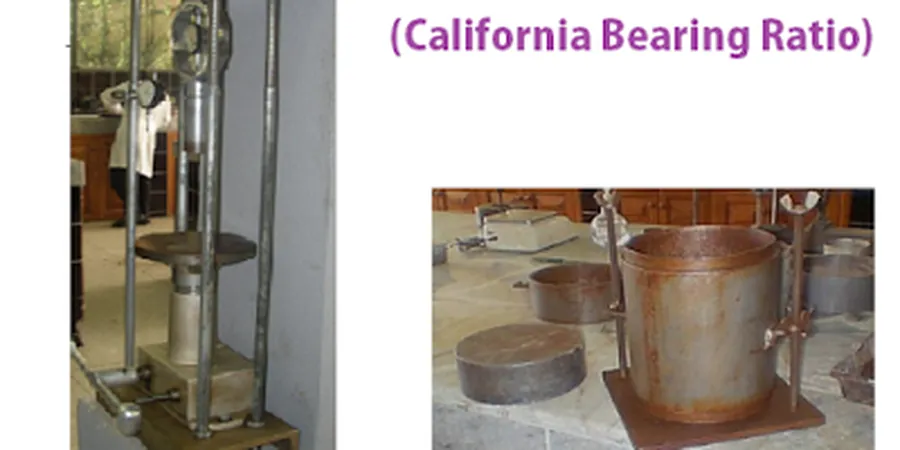
Designing a pavement structure in Laval-duvarie versus Fabreville reveals two completely different soil realities. The silty sands near the Rivière des Prairies in western Laval behave nothing like the sensitive Champlain Sea clays that dominate the central plateau around Chomedey and Pont-Viau. A laboratory CBR test becomes the only reliable way to quantify that difference before selecting subbase thicknesses. Our lab processes remolded specimens under controlled moisture and density conditions, following ASTM D1883-21 procedures, to determine the California Bearing Ratio that directly feeds into the AASHTO 1993 pavement design equation. For projects near the Sainte-Rose escarpment, where the till veneer is thin and variable, we often recommend pairing the in-situ permeability testing with the CBR to confirm drainage characteristics that affect long-term subgrade performance. Laval’s freeze-thaw cycles, averaging 80 per winter season, make accurate soaked CBR values non-negotiable for any road that has to survive beyond its first spring.
A soaked CBR difference of just 2 percentage points can change the required granular base thickness in Laval by over 150 mm.
Local considerations
The loading press applies force at exactly 1.27 mm per minute, a speed that would feel glacial to anyone watching but is critical for replicating the slow deformation pavement experiences under traffic. In Laval, where the clay subgrade moisture content fluctuates seasonally by up to 12 percentage points between August and April, a laboratory CBR test performed on specimens at the wrong molding water content produces dangerously optimistic results. The biggest technical risk involves sample preparation: field samples from the Sainte-Dorothée area often arrive with silt lenses that must be homogenized carefully or the CBR value becomes meaningless. Our technicians trim, compact, and soak each specimen inside a humid room maintained at 23°C ± 2°C, tracking swell measurements every 24 hours. A specimen that swells more than 5% during soaking signals a subgrade that will heave badly under winter frost penetration, a condition we flag immediately in the geotechnical report because it overrides the CBR number itself in design significance.
Frequently asked questions
What is the typical turnaround time for a laboratory CBR test in Laval?
Standard reporting takes five to seven business days from sample reception. The 96-hour soaking period is fixed by ASTM D1883 and cannot be shortened. Expedited unsoaked CBR testing can be completed in 48 hours for time-sensitive projects such as emergency utility trench reinstatements.
How much does a laboratory CBR test cost for a Laval project?
Pricing for a single-point laboratory CBR test in Laval ranges from CA$150 to CA$290, depending on whether soaking is required and how many compaction points are specified. A full three-point CBR curve with soaking costs toward the upper end of that range.
Which compaction standard should be used for the CBR specimen preparation?
The choice between Standard Proctor (ASTM D698) and Modified Proctor (ASTM D1557) depends on the pavement layer. Laval municipal specifications for residential streets typically reference Standard Proctor at 95% maximum dry density for subgrade and 98% for subbase. Modified Proctor is generally reserved for highway projects under MTQ jurisdiction.
Can CBR values from Laval clay subgrades be used directly for flexible pavement thickness design?
Yes, but with an important local caveat. The AASHTO 1993 design method uses the CBR to determine the structural number, yet Laval's Champlain Sea clays lose significant strength under repeated freeze-thaw cycling. We recommend applying a seasonal adjustment factor of 0.6 to 0.8 on the laboratory CBR when the water table is within 1.5 m of subgrade elevation, a condition common across much of central Laval.