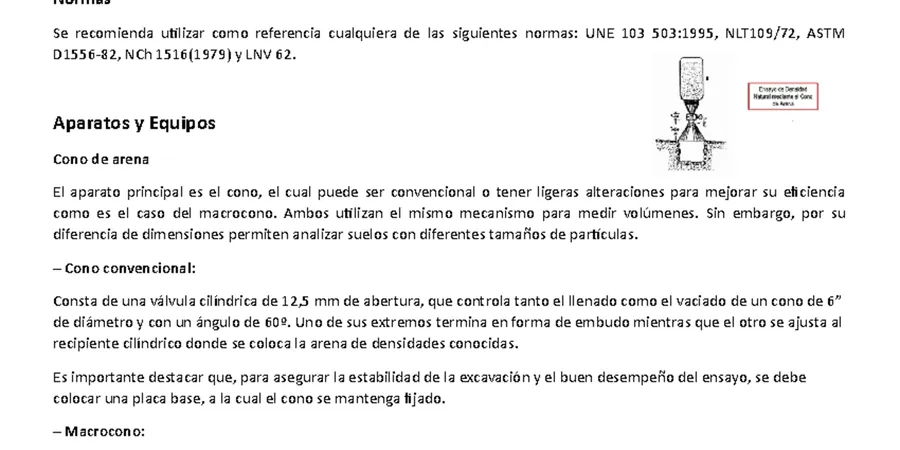
Laval sits on a complex glacial footprint carved by the retreat of the Laurentide Ice Sheet, with roughly 440,000 people now living atop a thin veneer of Champlain Sea clay and stony till that rarely exceeds 20 meters of overburden. Every cubic metre of engineered fill placed on ÃŽle Jésus has to answer to a simple question: is it dense enough? The field density test with the sand cone method gives contractors and geotechnical engineers a direct, volumetric answer. In a jurisdiction where frost penetration routinely reaches 1.5 metres, poorly compacted backfill behind a foundation wall is not a cosmetic defect — it is a future heave-and-settlement claim waiting for the first January thaw. Our laboratory runs ASTM D1556 procedures across Laval-des-Rapides, Chomedey, and Sainte-Rose, adapting the cone apparatus to coarse granular soils that would choke a nuclear gauge. When the site calls for deeper stratigraphic control, we often pair the surface density measurements with spt-drilling to verify that the bearing stratum below the compacted lift has not been disturbed by seasonal moisture cycling.
Municipal inspectors in Laval increasingly request sand cone results for utility trench backfill because the method leaves a physical sample that can be sieved later — an advantage that non-destructive nuclear methods simply cannot offer. The test itself is low-tech in appearance but demanding in execution: the Ottawa sand must be calibrated daily against the site’s ambient humidity, and the excavated hole profile has to be inspected for lost fines before the density calculation is accepted. When a contractor questions whether the fill meets the 95% modified Proctor target specified in the contract, the sand cone provides a defensible number that holds up during arbitration. For roadbase acceptance under flexible pavement, we combine the field density result with a companion proctor-tests laboratory curve to establish the relative compaction ratio required by the MTQ standard.
A single sand cone test on a utility trench in Laval can prevent the differential settlement that turns a minor water leak into a pavement collapse two winters later.
Methodology and scope
The post-war expansion of Laval transformed farmland into a patchwork of residential subdivisions and industrial parks, and that history is written directly into the fill profiles we test today. Many parcels levelled during the 1960s used uncontrolled borrow that contains lenses of organic silt and wood debris — material that passes a visual inspection but fails a sand cone test because the matrix compresses under the tamping energy before the specified density is reached. In these situations the field density test functions less as a pass-fail gate and more as a forensic tool that tells the engineer where the fill needs to be undercut. The sand cone method excels on the compacted crushed-stone working platforms that support
deep-excavations for Laval’s growing number of mixed-use towers near the Montmorency terminus, where a single weak lift under a crane pad can cascade into a safety stand-down. The procedure follows a definite sequence: the baseplate is seated on a levelled surface, the test hole is hand-excavated to the full lift thickness while all removed material is sealed in a bag, the calibrated Ottawa sand flows from the jar into the cavity, and the mass of sand remaining is weighed to compute the volume with a precision of plus or minus one percent. Our field crews have learned to anticipate the three most common failure modes on Laval sites: bridging of coarse aggregate that creates void pockets, moisture migration from the underlying clay into the test sand during humid August afternoons, and vibration from nearby compaction equipment that settles the sand in the cone before the valve is closed. Each of these introduces a bias that inflates the density reading, and catching them requires a technician who understands not just the standard but the soil behaviour of the region. When fill contains cobbles larger than 50 millimetres, we substitute the sand cone with a
cpt-test profile through the suspect lift to identify density anomalies without excavating a cavity that would violate the method’s maximum particle-size constraint.
Local considerations
The freeze-thaw pendulum in Laval — where ground temperatures cross zero Celsius more than sixty times in a typical winter — turns marginal compaction into a progressive failure mechanism. A trench backfill placed at 88% relative compaction may pass a visual inspection in October, but by March the ice lenses that nucleated in the air voids have melted, the soil structure has collapsed, and the asphalt patch above it has subsided into a pothole that the city attributes to the contractor. The sand cone test, performed immediately after compaction and before the first frost, captures the as-built density before cryogenic processes can alter the fabric. On the clay-rich tills of eastern Laval, the risk is not just settlement but also trapped pore pressure: an over-compacted clayey fill can develop negative pore pressures that draw water from the surrounding native soil, swelling the backfill and heaving shallow footings. Our team has documented this exact mechanism at a light-industrial project near Autoroute 440 where floor slabs began doming within six months of occupancy. The investigation traced the problem to a fill layer that had been compacted to 100% of standard Proctor but placed at 4% above optimum moisture content — conditions that a nuclear gauge would have missed because it averages over a volume that masks moisture layering. The sand cone, by extracting a discrete sample, allowed the laboratory to perform atterberg-limits on the same material and confirm that the fill was still above its plastic limit when it was compacted, a violation of the project specification that the density number alone had not revealed.
Frequently asked questions
What does a sand cone field density test cost on a typical Laval residential site?
For a standard single-location sand cone test within the Laval area, budget between CA$130 and CA$220 per test, depending on the number of tests requested on the same visit and the accessibility of the compacted surface. The price includes the field procedure, daily sand calibration, moisture-content determination, and a digitally signed report with the relative compaction calculation.
Why choose the sand cone method over a nuclear density gauge in Laval?
The sand cone method is not subject to the federal CNSC licensing requirements that govern nuclear gauges, which simplifies site access and eliminates the need for a radioactive-source security plan. More importantly for Laval soils, the sand cone physically excavates the compacted material, allowing the technician to inspect the hole profile for oversize particles and recover a sample for laboratory moisture-content verification — something a nuclear gauge cannot provide.
How deep does the sand cone test go and can it measure multiple lifts at once?
The standard sand cone test measures the density of one compacted lift, typically 100 to 150 millimetres thick. It is not designed to measure multiple lifts simultaneously because the excavated hole must have a consistent diameter from top to bottom. If you need density profiling through thicker fill sections, we recommend supplementing the sand cone with an SPT borehole or CPT sounding to capture the variation with depth.
Does the sand cone test work on coarse crushed stone used for Laval road bases?
The method works reliably on crusher-run material with nominal maximum aggregate size up to 50 millimetres. For clean, open-graded stone larger than that, the Ottawa sand can infiltrate the voids and produce an erroneously low volume measurement. In those cases we use a larger-volume replacement apparatus or switch to a water-replacement method where site conditions permit.