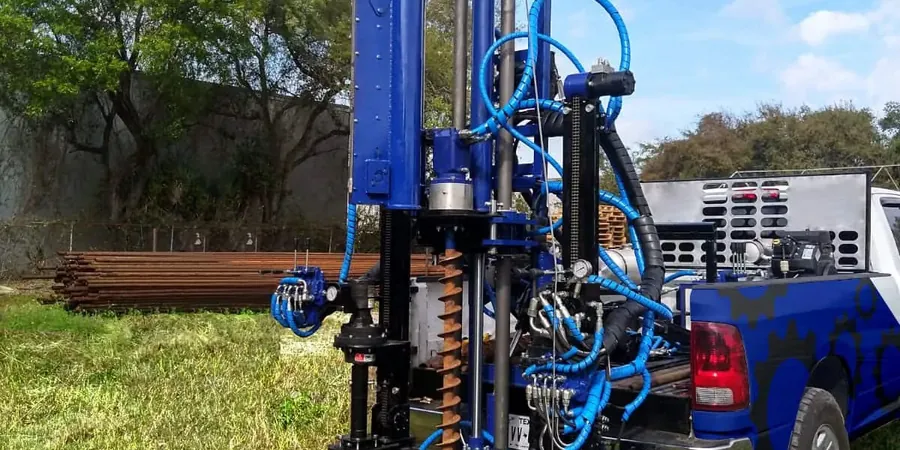
The CME-75 drill rig moves onto the Laval site, and within minutes the automatic hammer is lifting and dropping the 140-pound weight. That consistent 30-inch free fall drives the split-spoon sampler 18 inches into the glacial till. We count the blows. That N-value is your foundation's starting point. The SPT has been the backbone of North American geotechnical investigation since the 1940s, and on Ile Jesus, where the subsoil shifts from dense till to compressible marine clay in less than 50 meters, those blow counts matter. We correlate N-values directly to bearing capacity, friction angle, and liquefaction resistance. No guesswork. When the sampler comes up, we log recovery, moisture, and stratigraphy on the spot. For deeper profiling in sensitive clay zones, we often pair the SPT with CPT testing to capture continuous tip resistance and pore pressure data without disturbing the sample.
N-value alone is not a design parameter. We convert it to N60, correct for overburden, and correlate to phi angle and undrained shear strength. That is what your structural engineer actually needs.
Local considerations
We drilled a borehole behind a strip mall on Boulevard des Laurentides for a proposed three-story addition. The first 4 meters showed stiff clay with N-values around 12. Solid, right? At 5.5 meters, the split spoon sank under its own weight for 12 inches before we even started counting. N-value of 1. That was a buried Champlain Sea clay lens, highly sensitive and prone to strength loss if remolded. The structural design changed completely. We went from a conventional spread footing to a rigid inclusion ground improvement scheme. Without the SPT, that soft layer would have been missed by a hand auger or test pit. In Laval, where clay sensitivity can exceed 30, missing a weak layer means differential settlement and cracked slabs. The SPT gives you incremental data every 18 inches. That resolution catches the soft seams that mapping alone cannot predict.
Frequently asked questions
What does an SPT test cost in Laval?
A single SPT borehole to 10 meters depth with sampling at 1.5 m intervals runs between CA$770 and CA$940. The price includes the drill rig mobilization within Laval, technician labor, split-spoon sampling, field logging, and the data reduction report. Deeper boreholes or projects requiring multiple holes are priced per meter drilled.
How many boreholes does my Laval project need?
The NBCC requires a minimum of one borehole per 200 m² of building footprint for Site Class C through E, which covers most of Laval. For a typical single-family home, two boreholes at opposite corners are standard. Commercial buildings on variable Champlain Sea deposits often need boreholes at 15 to 20 meter spacing to capture lateral stratigraphic changes.
What is the difference between N-value and N60?
Raw N-value is the total blow count for the last 12 inches of sampler penetration. N60 corrects that raw count to 60% of the theoretical free-fall energy, which is the reference standard in ASTM D1586. Automatic hammers in our rigs typically deliver 65-70% energy, so the correction factor is often around 0.9. N1(60) further corrects for overburden pressure. Your structural engineer should use N60 or N1(60), never raw N.
How long after drilling do I get the SPT report?
You receive the field borehole log with raw N-values and visual soil descriptions before we demobilize the rig. The full geotechnical report with corrected N60 values, phi and Su correlations, NBCC Site Class, and foundation recommendations is delivered within five business days. If you need preliminary bearing capacity numbers faster for a permit application, we can provide draft data within 48 hours.