← Home · Laboratory

Grain Size Analysis (Sieve + Hydrometer) in Laval — Reliable Lab Results from Local Soils

Together, we solve the challenges of tomorrow.

LEARN MORE →

We still see contractors in Laval who skip the full hydrometer test and just run a quick sieve. Then the fill gets placed, the fines migrate, and six months later the parking lot is a mess of differential settlement. The till-derived soils across Laval, especially in the eastern sectors toward the Rivière des Prairies, carry a surprising amount of silt and clay that a simple sieve analysis will miss. A complete grain size distribution curve — combining mechanical shaking and sedimentation — gives you the numbers that actually matter for compaction specs, frost protection, and drainage design. In a city where winter penetrates deep into the subgrade, guessing the fines content is the fastest way to lose your paving warranty. The team here runs both portions under one protocol, so you get a single report with the full particle-size range, ready for the City of Laval’s engineering department or your geotechnical consultant.

A sieve-only curve in Laval’s silty tills is a half-finished job — the fines dictate frost heave, drainage, and long-term compaction stability.

Methodology and scope

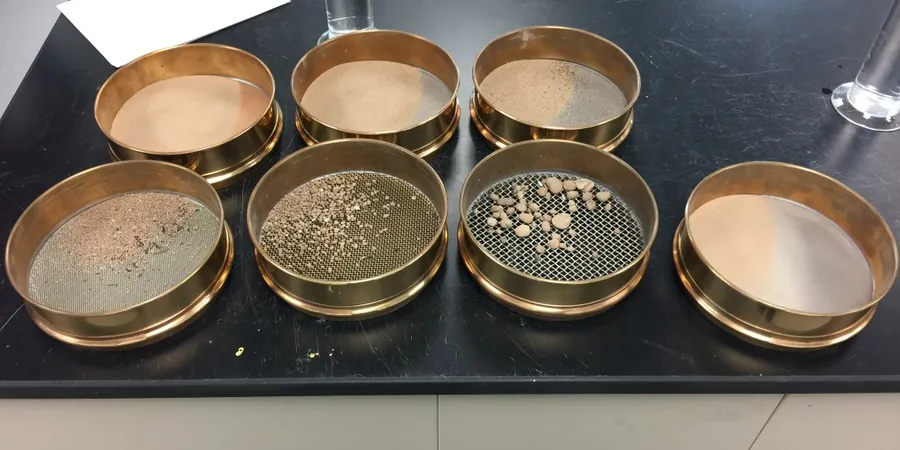
Laval’s expansion since the 1960s turned farmland and wooded lots into dense residential and industrial zones at a pace that sometimes outpaced subsurface documentation. Many older neighborhoods sit on Champlain Sea silts over glacial till — a layering that makes grain size data critical for foundation drainage and slab support. When we run a combined sieve and hydrometer analysis, we are looking at everything from gravel down to colloidal clay. The standard procedure splits the sample at the No. 200 sieve: coarse fraction goes through a stack of sieves per ASTM D6913, while the fine fraction is dispersed in solution and measured with a hydrometer over a 24-hour period per ASTM D422. For projects near the Mille Îles River, where alluvial lenses appear unpredictably, this full curve is essential — it tells you whether your material qualifies as free-draining or moisture-sensitive. Contractors who also need compaction control often pair this with a proctor test to nail the moisture-density relationship on the same soil. In commercial developments along Autoroute 15, we frequently combine grain size with Atterberg limits to flag high-plasticity clays before they end up under a warehouse floor.
Grain Size Analysis (Sieve + Hydrometer) in Laval — Reliable Lab Results from Local Soils
Technical reference image — Laval

Local considerations

We see it often in Laval’s industrial parks: a contractor imports granular fill from a Drummondville pit, assumes it is clean sand, and skips the hydrometer. Then a spring thaw hits and the parking lot heaves unevenly because the ‘clean’ fill actually carried 12% fines. That is a six-figure repair that a grain size analysis would have prevented. The risk isn’t just frost — it is also about permeability. Soils with more than 5% passing the 75 µm sieve can hold water against foundation walls, leading to hydrostatic pressure problems that no weeping tile can fix if the backfill itself is the culprit. In the residential sectors of Chomedey and Sainte-Dorothée, where basement walkouts are common, misclassifying a silty sand as free-draining creates chronic dampness. The full sieve-plus-hydrometer report gives you the coefficient of uniformity and gradation curve needed to make an informed call on filter compatibility, frost susceptibility, and compaction specification.

Need a geotechnical assessment?

Reply within 24h.

Email: contact@geotechnical-engineering.org

Technical parameters

ParameterTypical value
Test standard (coarse fraction)ASTM D6913 / AASHTO T-311
Test standard (fine fraction)ASTM D422 / AASHTO T-88
Sieve range75 mm to 75 µm (No. 200)
Hydrometer range75 µm to ~1 µm (clay fraction)
Sample mass (coarse)500 g – 20 kg depending on max particle size
Dispersing agentSodium hexametaphosphate (Calgon)
Typical reportingParticle-size distribution curve, Cu, Cc, % gravel/sand/silt/clay
Lab accreditationISO 17025 compliant, City of Laval recognized

Associated technical services

01

Combined Sieve + Hydrometer Package

Full gradation curve from 75 mm down to 1 micron. Includes oven-dry moisture, wash through No. 200, mechanical sieve shaking, and 24-hour sedimentation with hydrometer readings at standardized intervals. Delivered as a signed PDF with the distribution plot and summary table.

02

Wash Sieve Only (Coarse Fraction)

For granular base and concrete sand verification. Sample washed over the 75 µm sieve, dried, and shaken through a full stack. Reports percent passing each sieve, fineness modulus when requested.

03

Hydrometer Only (Fine Fraction)

When you already have the coarse curve and just need the silt-clay split. Sample dispersed with sodium hexametaphosphate, temperature-controlled sedimentation cylinder, readings at 2, 5, 15, 30, 60, 250, and 1440 minutes.

04

Expedited Site Material Classification

Fast-turnaround grain size with visual-manual classification backup (ASTM D2488) for time-sensitive earthworks decisions. Ideal for confirming fill suitability during active cut-and-fill operations in Laval subdivisions.

Applicable standards

ASTM D422-63(2007) — Standard Test Method for Particle-Size Analysis of Soils (Hydrometer), ASTM D6913/D6913M-17 — Standard Test Methods for Particle-Size Distribution (Gradation) of Soils Using Sieve Analysis, AASHTO T-88 — Particle Size Analysis of Soils, BNQ 2501-025 — Sols — Analyse granulométrique (Quebec reference), CSA A23.2-2A — Sieve analysis of fine and coarse aggregates (when testing concrete sand)

Frequently asked questions

How much does a grain size analysis (sieve + hydrometer) cost in Laval?

A combined sieve and hydrometer test on a single sample typically runs between CA$120 and CA$280, depending on whether you need the full curve or just one portion. Expedited turnaround adds a surcharge. We quote by the sample, so if you are running a quality control program with multiple lifts, we can set up volume pricing. Contact the lab with your project specs for a firm number.

How long does the hydrometer portion take?

The hydrometer sedimentation test requires a minimum of 24 hours of undisturbed settling time, plus sample preparation and dispersion. Most combined reports are ready in 48 to 72 hours from sample receipt. If you only need the sieve portion, we can often turn that around the same day.

What sample size do you need for the full test?

For a combined sieve and hydrometer analysis, we typically need about 500 grams of material passing the No. 10 sieve for the hydrometer portion, plus enough bulk sample to represent the coarse fraction — usually 2 to 5 kg total. If the soil contains gravel larger than 19 mm, we will need more material to get a statistically valid split. We supply sample jars and instructions.

Do you provide the gradation curve ready for City of Laval permit submissions?

Yes. The final report includes the semi-log particle-size distribution plot, the coefficients of uniformity and curvature, and the percent gravel, sand, silt, and clay fractions — formatted to meet the City of Laval’s engineering submission requirements. We also include chain-of-custody documentation and lab accreditation references.
Location and service area

We serve projects across Laval and its metropolitan area.

View larger map