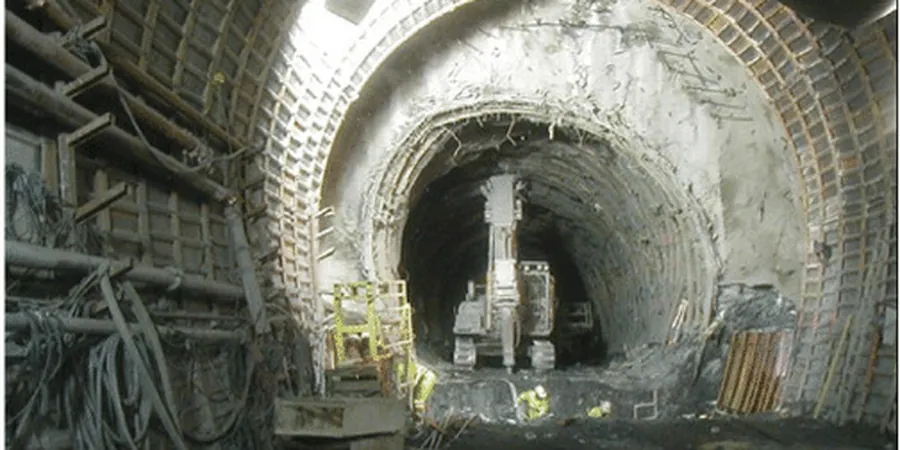
Laval sits squarely within the St. Lawrence Lowlands, underlain by up to 30 meters of sensitive Champlain Sea clay deposited roughly 10,000 years ago. This marine clay, known locally for its metastable fabric and pronounced loss of strength when disturbed, defines every underground project on Île Jésus. In our experience, tunneling here without a detailed site investigation with CPT is a gamble that almost always leads to costly surprises. The Rivière des Prairies and Rivière des Mille Îles keep the water table high year-round, meaning that even a moderate tunnel depth deals with full hydrostatic pressure. Add the NBCC 2015 seismic hazard values for the region—peak ground accelerations near 0.38 g for the 2% in 50-year event—and you quickly understand why a conventional rock-tunnel approach fails. Soft-ground tunneling in Laval demands a geotechnical framework that marries undrained shear-strength profiling, consolidation analysis, and seismic deformation assessment from the very first borehole.
Sensitive Champlain clay loses over 80% of its undisturbed strength when remolded; tunnel stability here depends on preserving that fabric during every excavation step.
Local considerations
Laval’s humid continental climate brings freeze-thaw cycles that penetrate the stiff crust, perched groundwater tables in spring, and occasional summer cloudbursts that saturate the near-surface weathered clay. These seasonal swings matter for soft-ground tunneling because they alter the effective stress regime in the first 5 meters, right where tunnel portals, access shafts, and cut-and-cover transition zones are located. The contrast between a frozen January crust and a saturated April clay can shift lateral earth pressures by 30% or more on temporary support systems. The greater danger, however, is large-scale strength loss due to remolding: a localized face instability in sensitive Champlain clay can propagate into a retrogressive flow slide if pore pressures cannot dissipate fast enough. This is precisely why we tie every stability calculation to the liquidity index and sensitivity values measured from undisturbed samples, rather than relying on generic clay parameters pulled from a textbook. Proactive instrumentation—vibrating-wire piezometers and in-place inclinometers—provides the real-time feedback that makes the difference between a controlled advance and a ground-loss event.
Frequently asked questions
How does Champlain clay affect tunnel boring machine selection in Laval?
Champlain clay’s high sensitivity and tendency to remold require an earth-pressure-balance (EPB) machine with strict face-pressure control. The cutterhead must be designed to minimize disturbance, and conditioning with polymer foams helps maintain a consistent paste that supports the face while reducing torque. Slurry TBMs are rarely used here because filtering the fines-laden slurry becomes expensive and the risk of blowout in soft, low-overburden zones is elevated.
What seismic considerations apply to soft-ground tunnels under NBCC?
Under NBCC 2015 and the companion structural geotechnical provisions, tunnels in Laval must be checked for ovaling and racking deformations induced by seismic shear-wave propagation. We typically run equivalent-linear site response analyses using measured Vs profiles from seismic CPT or MASW, then apply free-field shear strains to the tunnel lining in a beam-on-elastic-foundation model. For sensitive clay, we also evaluate cyclic softening and the potential for post-peak strength loss under repeated loading.
What is the typical cost range for a soft-ground tunnel geotechnical investigation in Laval?
A comprehensive investigation for a tunnel alignment in Laval—covering CPTu soundings, deep boreholes with piston sampling, advanced laboratory testing, and a geotechnical interpretive report with 2D/3D numerical analysis—generally runs between CA$5,480 and CA$23,930, depending on the alignment length, number of test locations, and the complexity of the required laboratory program.
How do you confirm that the tunnel crown stays stable during excavation?
Crown stability in soft Champlain clay is verified through a combination of real-time settlement monitoring at surface, radial convergence measurements inside the tunnel, and pore-pressure readings ahead of the face. The data is compared against pre-construction PLAXIS predictions. If the measured volume loss exceeds trigger levels—typically 0.5% for sensitive clay under urban infrastructure—face support pressure or grouting parameters are adjusted immediately.