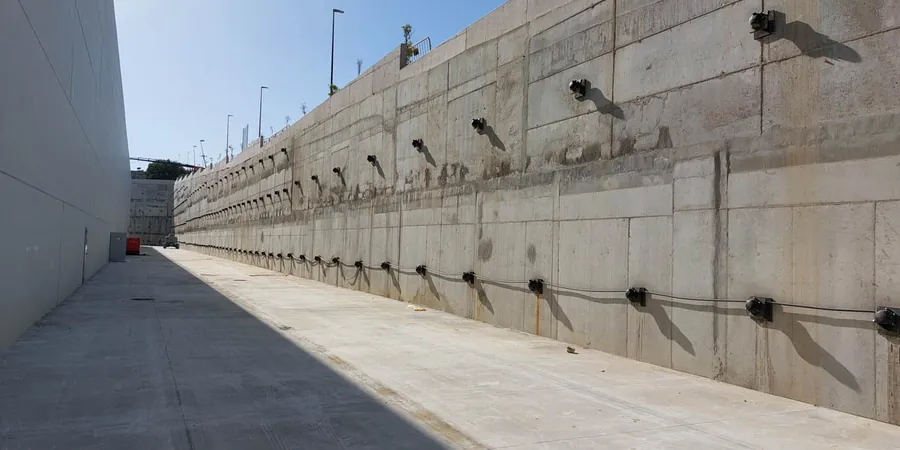
The post-glacial geology of Laval, with its extensive deposits of sensitive Champlain Sea clay interspersed with dense till, creates a challenging profile for earth retention. Our anchor design work here rarely follows a standard template. We see a sharp transition from the stiff, overconsolidated crust in the east near Saint-Vincent-de-Paul to the softer, normally consolidated clays dominating the western basin toward Sainte-Dorothée. Each borehole log tells a different story about undrained shear strength and preconsolidation pressure. The anchor type, whether active prestressed tendons or passive grouted bars, must be matched to these soil conditions with precise grout-to-ground bond calculations. This direct engagement with the local stratigraphy, verified through in-situ permeability testing, defines our technical approach to every retaining structure in the region.
In Laval's Champlain clay, effective anchor capacity hinges on the remolded strength at the grout-clay interface, not just the intact peak value.
Methodology and scope
Anchor design in Laval splits into two distinct behavioral zones based on soil reactivity. In the Chomedey sector, where granular lenses appear within the clay matrix, active anchors with staged prestressing control lateral movement during deep basement excavations. Further north in Fabreville, the continuous clay profile demands passive anchors that mobilize resistance through progressive strain, often requiring longer bond lengths to distribute load away from the sensitive zone. Our laboratory confirms grout mix performance under CSA A23.3 specifications, testing for bleed, compressive strength development at 7 and 28 days, and sulfate resistance given the occasional groundwater chemistry in Laval's buried valleys. Load transfer is never assumed; it is verified through sacrificial anchor testing on site, correlating elastic elongation with dial gauge readings to confirm the actual unbonded length. This data then feeds back into the design, adjusting the anchor spacing and inclination for the next row.
Local considerations
Laval sits at approximately 45 meters above sea level on a clay plain sculpted by the Rivière des Prairies and Rivière des Mille Îles. The 1988 Saguenay earthquake, though centered 250 km away, triggered a noticeable response in the region's soft soils and brought liquefaction and slope stability concerns into sharper focus for municipal building officials. For anchored walls, the primary risk is not tensile failure of the steel but progressive creep in the bond zone under sustained load. In sensitive clays, disturbance from augering can reduce the interface shear strength by 30 to 50 percent. We mitigate this through hollow-stem auger techniques and immediate grout placement. Long-term monitoring with load cells on selected anchors provides the verification that relaxation is within the design envelope, protecting the excavation over its service life.
Frequently asked questions
What differentiates an active anchor from a passive anchor in retaining wall design?
An active anchor is prestressed after grouting to apply a compressive force to the wall, controlling lateral movement from the start. A passive anchor is not prestressed; it only develops resistance as the wall moves and the tendon elongates. In Laval's sensitive clays, we often specify active anchors to limit deformation around adjacent services.
How do you determine the bond length in Champlain Sea clay?
Bond length is derived from a sacrificial anchor test program. We isolate a bond zone of known length, grout it, and pull it to failure after the grout reaches 28-day strength. The ultimate load divided by the grout perimeter and bond length gives us the unit bond stress, which is then divided by a factor of safety of 2.0 to 2.5 for the production design.
What is the typical cost range for anchor design and testing in Laval?
For a complete anchor package including design parameters, sacrificial testing, and production proof testing, the range is between CA$1.580 and CA$5.400, depending on the number of anchors, test complexity, and whether long-term load cell monitoring is required.
What corrosion protection level is required for permanent anchors in Laval?
Permanent anchors in Laval require double corrosion protection (DCP) per PTI recommendations. The strand is encapsulated in a corrugated sheathing filled with grout, and the entire assembly is placed inside a second corrugated duct. This is essential given the occasional sulfate content in the local groundwater.
How is anchor creep evaluated during proof testing?
After the anchor is loaded to the test load, we hold it for a period (typically 10 to 60 minutes) while recording movement with a dial gauge. The creep rate is the slope of the movement versus log-time curve. A rate exceeding 2.0 mm per log cycle indicates a potential bond zone issue, and the anchor must be re-grouted or replaced before acceptance.