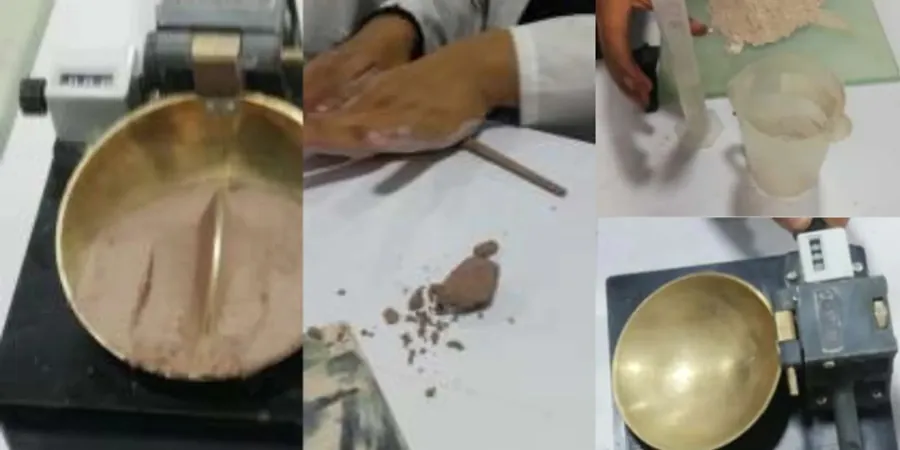
Laval's transformation from a patchwork of rural parishes into Quebec's third-largest city meant placing heavy infrastructure directly over the Champlain Sea clays that dominate the island. Anyone who has worked on a project east of Autoroute 15 or near the Rivière des Mille Îles knows the drill: you hit a gray, sensitive clay that looks firm in the cut but turns to slurry with a bit of water and vibration. That sensitivity is exactly where Atterberg limits become non-negotiable. The liquid limit and plastic limit define the moisture window where the clay transitions from a stable solid to a deformable plastic mass, and getting those numbers wrong has cost more than one Laval foundation a differential settlement headache. Our lab runs the full ASTM D4318 procedure on every cohesive sample, reporting the plasticity index and liquidity index so the geotechnical engineer can pin down the soil's behavior before the first bucket of concrete arrives. Between the rapid condo densification in Chomedey and the industrial expansions in the eastern sector, we are seeing more projects where the grain-size distribution alone is not enough to call the shot on bearing capacity. Pairing Atterberg limits with a reliable triaxial test gives the effective stress parameters needed to model the clay's long-term consolidation under load, which is the only way to avoid unpleasant surprises five years after occupancy.
A clay with a plasticity index above 30 in Laval's Champlain Sea deposits almost always signals sensitive, structured soil that loses strength when remolded.
Local considerations
Laval sits at roughly 45 meters above sea level, but the geotechnical risk is not about elevation—it is about the 12,000 years since the Champlain Sea retreated and left behind up to 60 meters of soft, saline clay in some sectors. The 1988 Saguenay earthquake, though centered 200 km away, still triggered small landslides in sensitive clay pockets across the St. Lawrence lowlands, reminding engineers that cyclic loading on high-PI clays can degrade stiffness faster than static analysis predicts. When Atterberg limits come back with a plasticity index exceeding 40 and a liquidity index near or above 1.0, the soil is telling you it is barely consolidated and will settle significantly under embankment loads. Skipping this five-test sequence because the SPT blow count looked reasonable is a gamble that has caused retaining wall tilts and sewer line separations in Sainte-Dorothée and Fabreville. The NBCC 2015 explicitly ties foundation design to the plasticity characteristics of the bearing stratum, and a proper classification per ASTM D2487 is the minimum bar for a defensible geotechnical report in this region.
Applicable standards
ASTM D4318-17e1: Standard Test Methods for Liquid Limit, Plastic Limit, and Plasticity Index of Soils, ASTM D2487-17: Standard Practice for Classification of Soils for Engineering Purposes (Unified Soil Classification System), NBCC 2015: National Building Code of Canada, Section 4.2, Foundations
Frequently asked questions
What do the Atterberg limits actually tell me about a Laval clay sample?
They quantify the moisture contents at which the clay changes from a brittle solid to a plastic paste (plastic limit) and from a plastic paste to a viscous liquid (liquid limit). The difference between the two—the plasticity index—measures the soil's capacity to hold water while remaining plastic. In Laval's Champlain Sea deposits, a high PI typically correlates with high compressibility and sensitivity, meaning the soil will settle more and lose strength if disturbed during excavation or pile driving.
How many points does the lab run for the liquid limit curve?
We run a minimum of four points spanning a range of 15 to 35 blows on the Casagrande cup, then fit the flow curve by linear regression to determine the moisture content at 25 blows. If the correlation coefficient drops below 0.99, we re-run the outliers. The one-point method is sometimes used for preliminary screening, but all final reports use the multi-point procedure.
What is the typical cost for Atterberg limits testing in Laval?
For a standard set covering liquid limit, plastic limit, and plasticity index on a single sample, you can expect a range between CA$100 and CA$160 per sample, depending on whether the sample requires pretreatment to remove organic matter or salts typical of the Champlain Sea deposits.
Do I need Atterberg limits if I already have a grain-size curve?
Yes, because the grain-size curve tells you the particle size distribution but says nothing about the mineralogy or the electrochemical interaction between clay platelets and pore water. Two soils with identical silt-clay fractions can have completely different Atterberg limits—one might be a low-plasticity rock flour, the other a high-plasticity sensitive clay that will behave very differently under load and saturation changes.