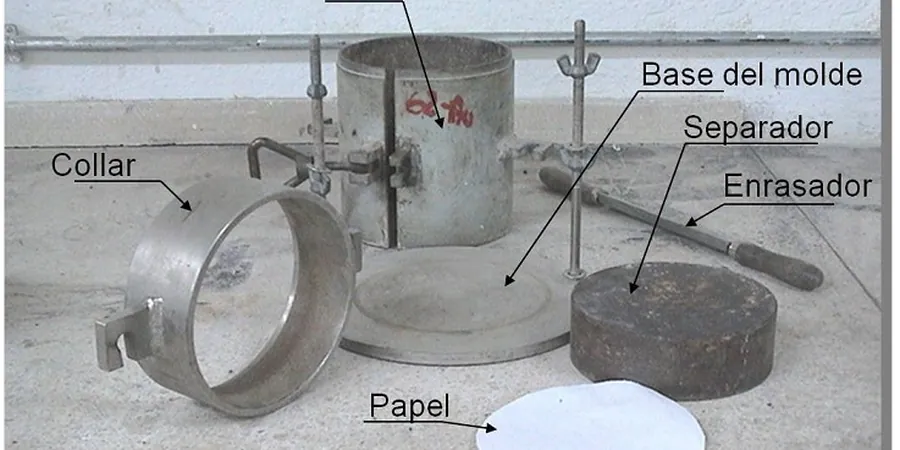
Laval sits on a complex glacial blanket where dense till ridges meet pockets of post-glacial marine clay. Drive ten minutes from Chomedey toward Auteuil and you'll see the subgrade change from stiff silty sand to a grey, high-plasticity material that holds water like a sponge. That variability is exactly why earthwork in Laval demands more than a generic compaction spec. The Proctor test establishes the moisture-density relationship for the specific borrow or on-site material you're actually placing. Without it, you're either over-compacting — wasting fuel and risking aggregate crushing — or leaving the lift loose enough that winter heave will dismantle your subgrade by March. Our laboratoire accrédité runs both Standard (ASTM D698) and Modified (ASTM D1557) curves, calibrated for the carbonate-rich tills that define the Île Jésus landscape.
A compaction spec without a site-specific Proctor curve is just a guess. Laval's glacial stratigraphy guarantees that the material under your blade today is not the same as what came out of the pit last week.
Local considerations
Comparing Laval-Ouest's sandy terrace deposits with the compressible clay basin underlying Pont-Viau illustrates the risk of applying a single compaction standard across the island. In Laval-Ouest, a Standard Proctor curve might suffice for landscaping fills, but the Modified energy is mandatory for structural backfill against foundations. In Pont-Viau, the native clay's sensitivity means its Proctor curve is nearly flat — small moisture deviations cause large density drops, and field compaction near optimum is difficult during spring thaw. If the contractor doesn't adjust the target moisture content for seasonal conditions, the post-winter nuclear gauge readings will come back below 95% standard density. That triggers rework, delays, and sometimes a redesign of the foundation drainage. We've also seen cases where imported granular borrow, placed without a verified Proctor reference, settled differentially under slab-on-grade construction in Sainte-Rose, cracking partition walls within two heating seasons. The test is not bureaucratic — it's the physical signature of the soil's mechanical response to compaction energy.
Applicable standards
ASTM D698-12 (Standard Test Methods for Laboratory Compaction Characteristics of Soil Using Standard Effort), ASTM D1557-12e1 (Modified Proctor), ASTM D4718-87 (Oversize Correction), BNQ 2501-255 (Soils - Determination of the compaction characteristics), NBCC 2015 Division B, Part 4 (Structural Design — requires compaction to 95% of Standard Proctor for engineered fill)
Frequently asked questions
Which Proctor standard applies to a residential foundation backfill in Laval — Standard or Modified?
The NBCC and most Laval municipal specifications require engineered fill beneath footings and floor slabs to achieve at least 95% of Standard Proctor maximum dry density (ASTM D698). However, for backfill against foundation walls that will support rigid pavement or driveway loads, the geotechnical report often specifies Modified Proctor (ASTM D1557) at 98% to minimize post-construction settlement. The choice depends on the structural engineer's bearing pressure and the plasticity of the on-site soil.
How does Laval's clay subgrade affect Proctor test results?
The Champlain Sea clays found across central and southern Laval have high plasticity indices (often 30–50%) and a relatively flat Proctor curve. This means the dry density doesn't change dramatically with water content, making it harder to identify a clear optimum. Our lab runs extra points on the wet side of optimum and adds the zero-air-voids line to define the practical compaction window. We also recommend field trial pads because lab curves for these clays can be sensitive to mellowing time.
What does a Proctor test cost for a Laval project?
A Standard or Modified Proctor test typically ranges from CA$160 to CA$320 per point, depending on mold size, oversize correction requirements, and whether we need to run a companion particle-size analysis. For projects requiring a family of curves across multiple material types, we provide a bulk rate. Contact the lab with your project location and material description for a precise quote.
How long does it take to get Proctor results in Laval?
Standard turnaround is 2 to 3 business days after sample receipt. If you're on a tight schedule — say, the compaction crew is mobilizing Monday morning — we can expedite results within 24 hours for a rush surcharge. The timeline assumes the sample is representative and we don't need to air-dry excessively wet clay, which can add a day for Laval's spring-condition materials.
Do you perform the Proctor test on recycled concrete aggregate (RCA) used in Laval?
Yes. Recycled concrete aggregate is increasingly common on Laval commercial sites, but its absorption and particle crushing behavior differ from natural granular soils. We run the Modified Proctor per ASTM D1557 with attention to the water added during mixing versus free water, and we apply the oversize correction if the RCA contains plus 3/4-inch fraction. We also recommend a pH and sulfate analysis for RCA placed near buried utilities.