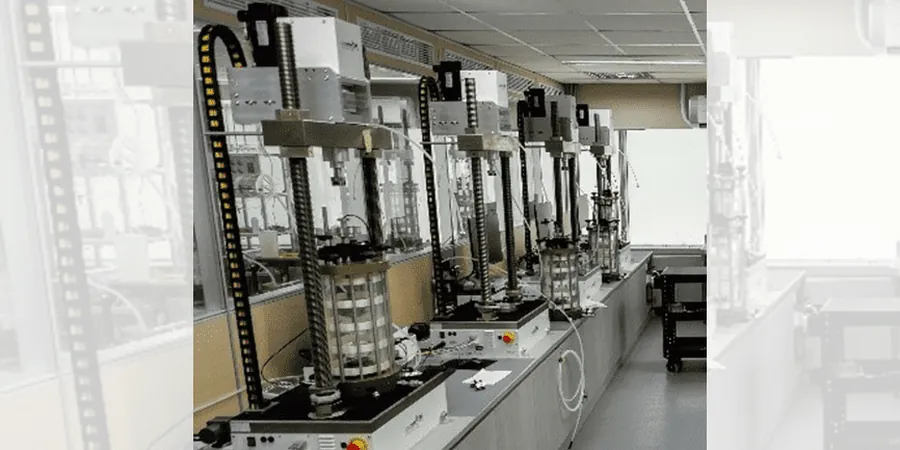
Most of Laval sits on a thick blanket of Champlain Sea clay, deposited roughly 10,000 years ago when the island was submerged. The upper crust can be stiff, but just a few meters down the sensitivity jumps dramatically. We have seen boreholes near Rivière des Mille Îles where the undrained shear strength drops to less than 15 kPa in the soft grey silty clay. In these conditions, picking a friction angle from a textbook correlation is a gamble. A proper triaxial test is the only way to extract reliable effective stress parameters, especially when the project involves deep excavations or embankments near the river. Combining this data with a CPT campaign often reveals thin sand lenses within the clay that can act as drainage layers during consolidation.
A single triaxial test on Laval's Champlain clay gives you more design certainty than a dozen empirical correlations from SPT blow counts.
Local considerations
Laval's transformation from a rural parish into a suburban hub of 450,000 people happened fast, and a lot of the older infrastructure near Chomedey and Pont-Viau was built before modern triaxial testing was common. We have investigated sites where the 1960s-era design assumed a drained friction angle of 32 degrees for the clay crust, but our CU tests showed an effective friction angle closer to 26 degrees with a small cohesion intercept that degrades with strain. The risk scenario is classic: a building on spread footings experiences differential settlement because the designer used peak strength, not realizing that Champlain clay loses structure at less than 2% axial strain. For retaining walls along the service roads, the lateral earth pressure distribution changes completely when the true effective stress path is known.
Frequently asked questions
Why can't I just use SPT N-values instead of running a triaxial test in Laval?
SPT correlations for shear strength are calibrated mostly for sands and stiff clays elsewhere. Laval's sensitive Champlain clay can show a reasonable N-value but still fail at low strain due to its meta-stable structure. A triaxial test measures the stress-strain curve directly, so you see the collapse behavior that an N-value misses entirely.
How much does a triaxial test program cost in Laval?
A full triaxial program, including three CU specimens with pore pressure measurement and a complete report, typically ranges from CA$2,620 to CA$4,090 depending on the number of specimens and the consolidation stages required. We always quote per project after reviewing the borehole logs.
What sample quality do you need for a reliable triaxial test?
We need undisturbed Shelby tube samples, 75 mm diameter minimum, sealed with wax immediately after extrusion in the field. The tubes must be transported vertically and without vibration. For CD tests on sand lenses, we sometimes use frozen samples or block samples from test pits to preserve the fabric.
How long does it take to get triaxial test results?
A standard CU triaxial test with back-pressure saturation can take 7 to 10 days from sample setup to report. CD tests on fine-grained soils take longer, up to two weeks, because of the slow drained strain rate. We can provide preliminary parameters earlier if the project schedule is tight.
Can you model the stress path for an excavation near the Rivière des Prairies?
Yes. We run stress-path triaxial tests where we reduce the confining pressure while holding the axial load to simulate lateral unloading during excavation. This gives a much more realistic stiffness and strength for the excavation sidewalls than a standard compression test.